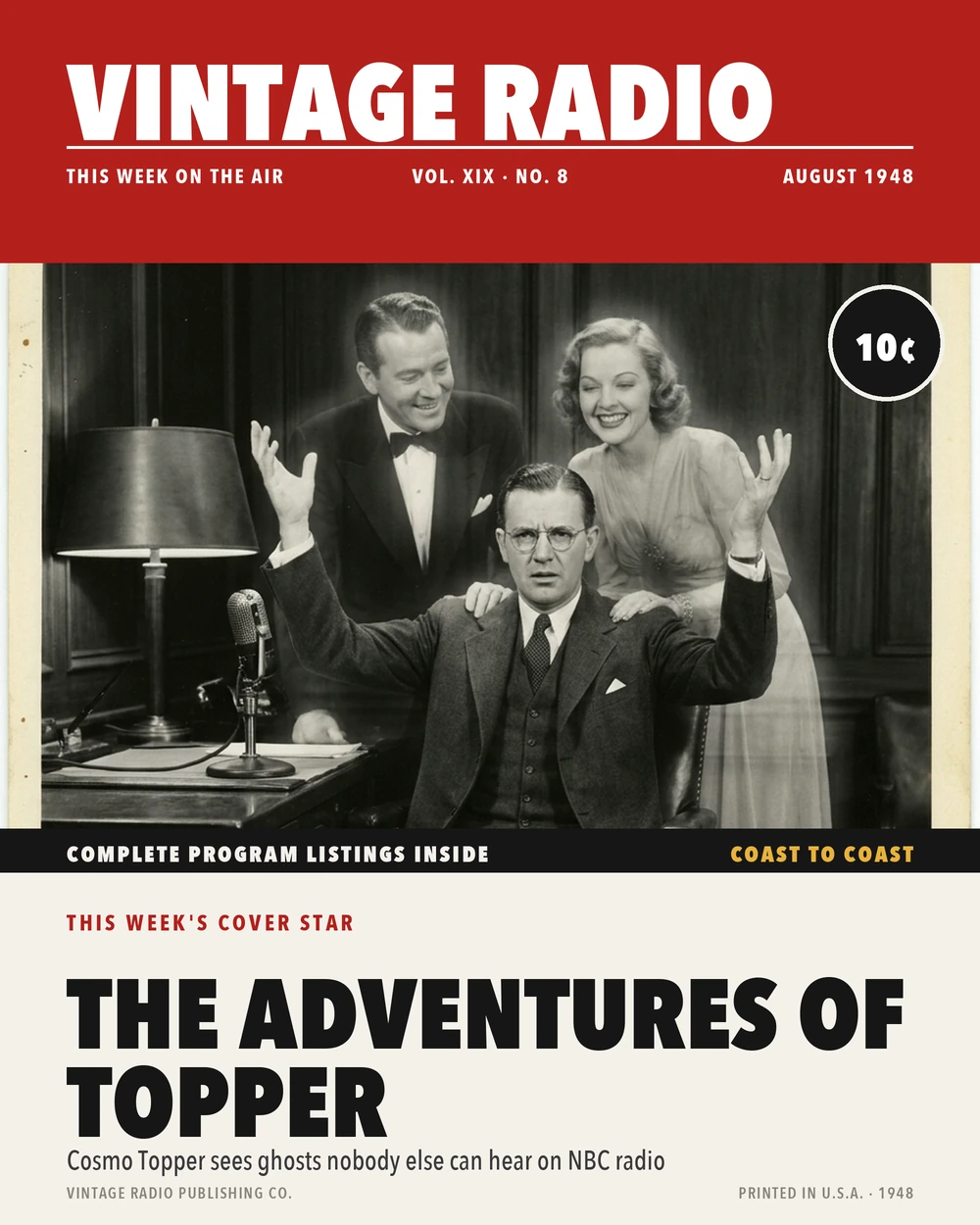
The Adventures of Topper
A Premise Built for the Wrong Medium
The central joke of The Adventures of Topper is a good one: a respectable banker named Cosmo Topper can see and hear two cheerful ghosts that nobody else around him can perceive. Every conversation he has with George and Marion Kerby looks, from the outside, like a man talking to himself or muttering at strangers. The comedy lives in that gap — what Topper knows versus what everyone else sees. It's a strong setup. The problem, as Variety's reviewer pointed out at the time, is that radio is an audio-only medium, and ghosts who appear and disappear are considerably harder to sell when the audience can't see anyone vanishing. The visual mechanics of the joke, which had worked beautifully in the 1937 film and would work again on television, didn't translate as cleanly to sound.
That limitation is probably why the NBC run stayed short — fifteen episodes across the summer of 1945, no renewal for fall. But the show is worth knowing as the only radio version of a property that had already become a genuine pop-culture staple and would go on to become one of early television's recognized hits.
How It Got on the Air
The show launched June 7, 1945, as a summer replacement for The Dinah Shore Show, which was on hiatus. NBC slotted it into Thursdays at 8:30 on WEAF, New York, with General Foods as the overall sponsor — Post Toasties cereal and Maxwell House Coffee both got featured billing. There's a small footnote to that sponsorship worth mentioning: Thorne Smith, who created the Topper characters in his 1926 novel, was a descendant of Don Jose Maxwell, for whom Maxwell House Coffee was named. Smith's mother was Maxwell's granddaughter. The fact that his fictional banker ended up selling Maxwell's coffee over the air is the kind of coincidence that sounds invented but apparently wasn't.
The series was originally contracted for thirteen weeks, but it pulled enough of an audience that two additional episodes were added, filling the time slot of The Burns and Allen Program during its own summer break — airing just before Dinah Shore when she returned. The final two episodes moved to 8:00. Stanley J. Wolf produced and wrote the scripts; Kirby Hawks directed.
The Cast
Roland Young had already been playing Cosmo Topper for eight years when the radio series began. He originated the role in the 1937 film Topper, directed by Norman Z. McLeod, which also starred Cary Grant as George Kerby and Constance Bennett as Marion Kerby. That performance earned Young an Academy Award nomination for Best Supporting Actor. Two sequels followed — Topper Takes a Trip in 1938 and Topper Returns in 1941 — and Young's face had become inseparable from the character.
His presence on the radio show wasn't a stretch, then, but it did serve a specific logistical purpose. Young was already a regular on The Dinah Shore Show, the program the Topper series was replacing for the summer. Putting him in the lead role gave the replacement series a sense of continuity with the audience already tuned to that time slot. Born in England on November 11, 1887, and trained at the Royal Academy of Dramatic Art, Young had a particular gift for playing mild, beleaguered men who maintain their dignity while the world makes fools of them — which is precisely what the Topper role required.
Hope Emerson played Topper's wife, referred to in surviving episode titles as Malvina (occasionally spelled Malveena), not the Henrietta of the later television version. George Kerby was played by Paul Mann, with Tony Barrett also heard in the role. Mann later had a notable film career of his own; he played Lazar Wolf in the 1971 production of Fiddler on the Roof. Marion Kerby was played by Frances Chaney, who had already built a solid radio résumé — she'd played the Burma character on Terry and the Pirates and co-starred in House in the Country on NBC-Blue. Ed Latimer rounded out the recurring cast.
Chaney's story after the show is one of the more striking in the supporting cast's histories. She married screenwriter Ring Lardner Jr. in September 1946. When Lardner refused to cooperate with the House Un-American Activities Committee in 1947, was cited for contempt of Congress, and served a prison sentence as one of the Hollywood Ten, Chaney's radio career effectively ended by association. She later said she would have been blacklisted regardless, for her own prior activities. Her return to television didn't come until the late 1950s, on the daytime soap The Edge of Night.
Thorne Smith and Where the Material Came From
Thorne Smith — full name James Thorne Smith Jr. — published the original Topper novel in 1926 after years working as an advertising agent in Greenwich Village. He'd grown up in Annapolis, Maryland, the son of a Navy commodore, and attended Dartmouth College. The novel and its 1932 sequel, Topper Takes a Trip, sold millions of copies in the 1930s and kept selling in paperback editions through the 1950s. Smith died young, of a heart attack while vacationing in Florida in June 1934, at 42 — never seeing any of the film or broadcast adaptations his characters inspired.
Roland Young had been a close personal friend of Smith's from around 1930 onward, and after Smith's death he wrote the only substantial biographical account of the author: a pamphlet-length work titled Thorne Smith: His Life and Times. That friendship likely deepened Young's connection to the material and gave his Topper something beyond standard character-actor competence.
Why the Radio Version Fell Short
Six of the fifteen episodes had been located by researchers as of the mid-2010s; the other nine remained missing. The episode titles that survive give a reasonable sense of what the scripts were doing — "Topper and the Psychiatrist," "Topper's Mother in Law Visits," "Topper and the Spiritualist" — which are exactly the kinds of situational complications you'd expect from a premise about a man who appears to be hearing voices. One of the two added episodes, the September 6 installment titled "Topper and the Spiritualist," ran an unusual hour in length.
The show was not renewed for the fall season. The Variety criticism David C. Tucker cited in The Women Who Made Television Funny touches on why: the comedy of ghosts materializing and dematerializing depends on the audience being able to see the absence. When Marion and George step out of a room, radio can tell you they're gone, but it can't show the empty space where they were standing. The premise was doing real work against its own medium.
What Television Did With It
Roland Young died on June 5, 1953, just months before the CBS television adaptation of Topper premiered that October. He never saw what became of the character he'd spent sixteen years playing.
The CBS series, which ran from October 9, 1953, to July 15, 1955, produced 78 episodes and cast Leo G. Carroll as Topper, with Anne Jeffreys and Robert Sterling as the Kerbys — who were, in the television version, killed in an avalanche while skiing, along with Neal, an alcoholic St. Bernard who had come to their rescue. Jeffreys and Sterling were married to each other in real life. Lee Patrick played Henrietta. The show was sponsored by R.J. Reynolds, and the Kerbys were contractually required to be seen smoking Camel cigarettes in every episode. Among the writers on the first season was Stephen Sondheim, who co-wrote eleven episodes with George Oppenheimer — including the pilot — in one of his earliest professional credits.
The television version succeeded where the radio version had struggled precisely because the camera could do what the microphone couldn't. The Kerbys could materialize, gesture, vanish, reappear, and the audience saw all of it. The show ran in syndication for more than a decade after its initial network run. Thorne Smith's premise — the supernatural intrusion into ordinary domestic life, comedy built on the gap between what the protagonist knows and what everyone else can see — proved influential enough that later series including Bewitched, Mr. Ed, and I Dream of Jeannie are credited as following in its wake.
The fifteen-week NBC summer run of 1945 sits at a particular moment in that history: after the films had established the property, before television had found what to do with it. As radio comedy, it was a reasonable try at something the medium wasn't quite suited to carry.